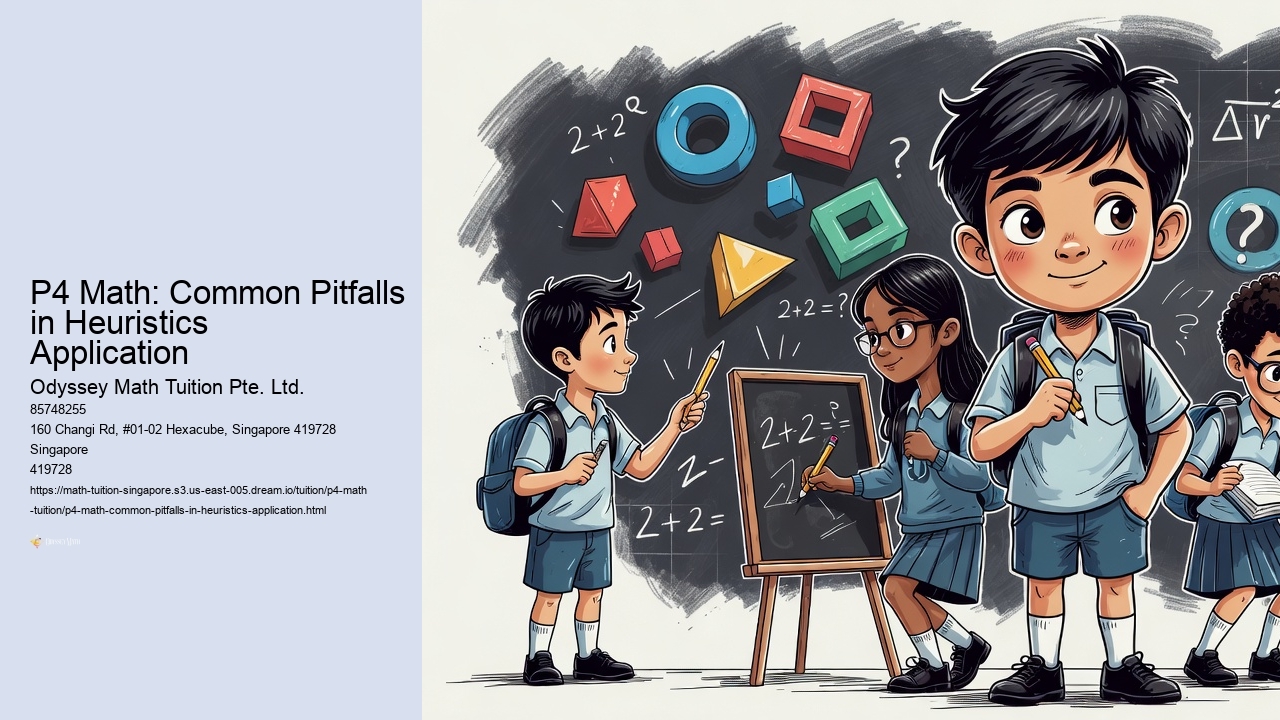
P4 Math: Common Pitfalls in Heuristics Application
Is P4 Math Suddenly Harder?
Ah, Primary Four. It's like the 'atas' (high-class) version of primary school, isn't it? Suddenly, the math problems seem to have sprouted extra limbs, and your child is staring blankly at questions they used to ace. Don't panic, parents! You're not alone in feeling this way. Many Singaporean parents experience a similar jolt when their child enters P4. In today's demanding educational scene, many parents in Singapore are seeking effective strategies to boost their children's grasp of mathematical concepts, from basic arithmetic to advanced problem-solving. Building a strong foundation early on can substantially improve confidence and academic performance, assisting students tackle school exams and real-world applications with ease. For those exploring options like p4 math tuition it's vital to prioritize on programs that highlight personalized learning and experienced guidance. This strategy not only resolves individual weaknesses but also fosters a love for the subject, contributing to long-term success in STEM-related fields and beyond.. It's a pivotal year, a bit of a 'kiasu' (afraid to lose) checkpoint, really, as it lays the groundwork for PSLE and beyond. Let's unpack why P4 Math feels like such a leap and how early, targeted support, like p4 math tuition, can make all the difference.
The Singapore MOE syllabus deliberately ramps up the difficulty in P4. It's not just about learning new concepts; it's about applying them in increasingly complex scenarios. Think of it as moving from simple addition to multi-step problem-solving that requires critical thinking. This is where heuristics, or problem-solving strategies, come into play. Suddenly, your child isn't just memorizing formulas; they're learning how to think mathematically.
And why is this so crucial? Because P4 performance significantly impacts your child's confidence and trajectory. It's the year where gaps can start to widen if not addressed promptly. These gaps can snowball, affecting their performance in upper primary and ultimately influencing their PSLE score, which has implications for secondary school streaming. No parent wants their child to feel discouraged or fall behind!
That's where early intervention, often in the form of p4 math tuition, becomes a game-changer. It provides that extra layer of support, helping your child master foundational concepts, develop essential math problem-solving skills, and build the confidence they need to tackle challenging problems. It's about nipping those potential problems in the bud before they become big headaches.
Fun fact: Singapore's emphasis on math education has consistently placed our students among the top performers in international assessments like TIMSS (Trends in International Mathematics and Science Study)! We are known to be good in Math, so let's keep it up!
Assessing Your Child's P4 Math Needs
So, how do you know if your child could benefit from p4 math tuition or additional support? It's not always about grades; sometimes, it's about observing their approach to learning and problem-solving.
Here are some tell-tale signs:
Struggling with Word Problems: Word problems are a significant part of the P4 curriculum. If your child consistently struggles to translate word problems into mathematical equations, it's a red flag.
Difficulty Applying Heuristics: Heuristics are problem-solving strategies, such as model drawing, guess and check, and working backwards. If your child is unable to apply these techniques effectively, they may need additional guidance.
Decreased Confidence: A noticeable drop in confidence when tackling math problems is a sign that they may be feeling overwhelmed.
Increased Time Spent on Homework: If your child is spending an excessive amount of time on math homework, it could indicate they are struggling with the concepts.
Avoidance of Math: Does your child suddenly groan or try to avoid doing their math homework? This could be a sign of frustration and a lack of understanding.
Ultimately, the goal is to identify any potential learning gaps early on. Don't wait until the end-of-year exams to realize your child needs help. Proactive assessment and early intervention are key to building a strong foundation and ensuring their success in P4 Math and beyond.
Interesting fact: Did you know that the model drawing method, a cornerstone of Singapore math, was developed to help students visualize and solve complex word problems more effectively?
Spotting Weaknesses in Key P4 Math Topics
Let's drill down into specific P4 Math topics where students often encounter difficulties. Recognizing these areas can help you pinpoint where your child might need extra support, perhaps through targeted p4 math tuition.
Fractions: Fractions are a foundational concept, and a weak understanding here can impact future learning. Look out for struggles with equivalent fractions, adding and subtracting fractions, and solving word problems involving fractions.
Decimals: P4 introduces decimals, and students need to understand the relationship between fractions and decimals. Difficulties may arise in converting between the two, performing operations with decimals, and applying them in real-world scenarios.
Geometry: Geometry concepts, such as area and perimeter, are introduced in P4. Students may struggle with visualizing shapes, applying formulas, and solving problems involving composite figures.
In the challenging world of Singapore's education system, parents are progressively focused on preparing their children with the abilities essential to excel in intensive math curricula, encompassing PSLE, O-Level, and A-Level preparations. Recognizing early signals of challenge in areas like algebra, geometry, or calculus can create a world of difference in developing tenacity and expertise over advanced problem-solving. Exploring dependable singapore maths tuition options can deliver tailored support that corresponds with the national syllabus, ensuring students obtain the edge they require for top exam results. By prioritizing engaging sessions and regular practice, families can support their kids not only achieve but exceed academic expectations, opening the way for upcoming opportunities in high-stakes fields..
Heuristics: As mentioned earlier, heuristics are crucial for problem-solving. Common pitfalls include choosing the wrong heuristic, misapplying the steps, or failing to identify the key information needed to solve the problem.
By identifying these specific areas of weakness, you can tailor your support to address your child's individual needs. This might involve working through extra practice problems, seeking clarification from their teacher, or enrolling them in a p4 math tuition program that focuses on these challenging topics. In this Southeast Asian hub's demanding education framework, where academic success is essential, tuition generally applies to private additional classes that provide targeted guidance in addition to school curricula, aiding pupils grasp subjects and gear up for significant exams like PSLE, O-Levels, and A-Levels in the midst of intense competition. This independent education sector has grown into a multi-billion-dollar market, fueled by parents' investments in tailored guidance to overcome knowledge shortfalls and enhance grades, though it often imposes stress on young learners. As artificial intelligence emerges as a transformer, investigating advanced online tuition singapore approaches uncovers how AI-driven tools are personalizing educational journeys internationally, delivering adaptive coaching that outperforms conventional practices in efficiency and engagement while resolving international learning gaps. In Singapore in particular, AI is revolutionizing the standard supplementary education model by allowing cost-effective , on-demand applications that align with countrywide curricula, likely reducing expenses for parents and enhancing outcomes through data-driven analysis, while principled considerations like excessive dependence on technology are discussed.. Remember, early intervention can prevent these weaknesses from snowballing into larger problems down the road.
History: The development of Singapore's math curriculum has been influenced by various pedagogical approaches, including the Concrete-Pictorial-Abstract (CPA) approach, which emphasizes hands-on learning and visual representations.
Heuristics are problem-solving strategies or rules of thumb that help simplify complex math problems, especially word problems. They provide a structured approach to tackle unfamiliar questions.
How can I help my child avoid common mistakes when using heuristics?
Ensure your child understands the underlying concept of each heuristic, practices regularly with varied problems, and learns to identify which heuristic is most appropriate for a given question. Encourage them to show their working clearly.
What is the Model Drawing heuristic, and why is it important?
Model drawing uses visual representations (bars, boxes) to understand relationships between quantities in a word problem. Its crucial for visualizing the problem and making it easier to solve, especially for part-whole and comparison problems.
My child struggles to choose the correct heuristic. What can I do?
Create a checklist of common heuristics and examples of when to use them. Practice identifying keywords in problems that suggest a particular heuristic. Review solved examples together, explaining the thought process behind the choice.
Whats the Guess and Check heuristic, and when should it be used?
Guess and Check involves making an initial guess, checking if it satisfies the problems conditions, and adjusting the guess based on the outcome. Its useful when theres no obvious formula or method, or when the problem involves a limited number of possibilities.
How does the Working Backwards heuristic work?
Working Backwards starts with the final result and reverses the steps to find the initial value. Its helpful when the problem describes a series of actions leading to a known outcome.
What is the “Restate the problem” heuristic?
Restating the problem in your own words helps your child better understand what the question is asking. It can clarify the information and identify what needs to be solved.
Is it okay if my child uses different heuristics to solve the same problem?
Yes! Sometimes, multiple heuristics can lead to the correct answer. The goal is to find a method that your child understands and can apply effectively. Encourage exploration and discussion of different approaches.
How can I make learning heuristics more engaging for my child?
Use real-world examples and scenarios to illustrate how heuristics can be applied. Turn problem-solving into a game or challenge. Celebrate successes and focus on the learning process, not just the final answer.
Where can I find more practice problems for P4 Math heuristics?
Many assessment books and online resources offer heuristics-based questions. Consider enrolling your child in a tuition program that focuses on heuristics training and provides ample practice opportunities.