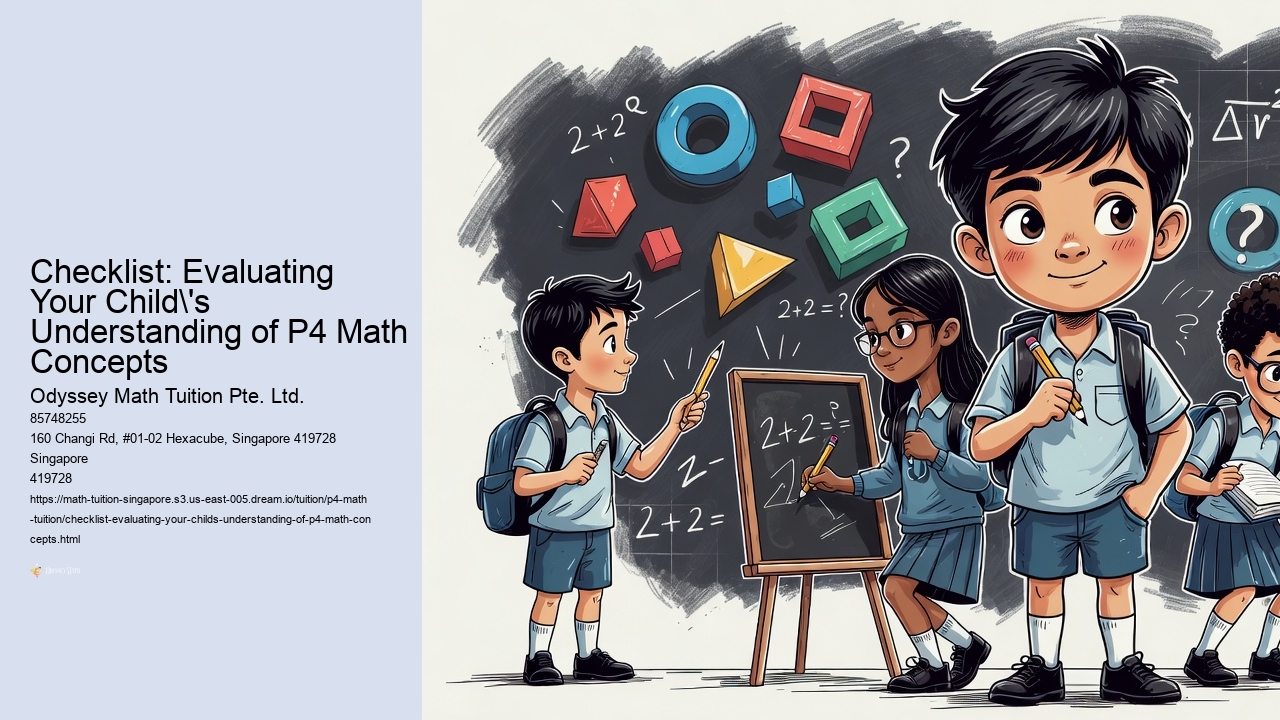
Checklist: Evaluating Your Child's Understanding of P4 Math Concepts
Is Your Child Keeping Up with P4 Math?
Right, lah, let's talk about something close to every Singaporean parent's heart (and maybe their rising blood pressure): Primary 4 Math. It's like the pasar malam of education – suddenly, there's so much more to see, so much more to worry about! This is the year things start getting real, the year those seemingly innocent numbers and shapes start morphing into… well, problems! And let's be honest, nobody wants their child kena left behind.
Assessing Your Child's P4 Math Needs
It's easy to get caught up in the kiasu spirit and assume your child needs extra help the moment they bring home a less-than-stellar math test. But hold your horses! Common Mistakes in P4 Math Word Problems: How to Avoid Them . In today's competitive educational environment, many parents in Singapore are hunting for effective strategies to improve their children's comprehension of mathematical principles, from basic arithmetic to advanced problem-solving. Creating a strong foundation early on can substantially elevate confidence and academic success, assisting students tackle school exams and real-world applications with ease. For those considering options like p4 math tuition it's essential to focus on programs that emphasize personalized learning and experienced guidance. This approach not only tackles individual weaknesses but also fosters a love for the subject, resulting to long-term success in STEM-related fields and beyond.. Before you rush into p4 math tuition, let's take a step back and assess the situation properly. After all, every child learns at their own pace, right?
First, ditch the knee-jerk reaction and have a chat with your child. Find out why they're struggling. Is it a specific concept, like fractions suddenly behaving like rebellious teenagers? Or is it a broader issue, like difficulty understanding word problems (those kan cheong inducing paragraphs that seem designed to confuse even adults)? Sometimes, just talking it out can reveal the root of the problem.
Next, review their past work. Don't just look at the final score; dig into the details. Where are they making mistakes? Are they consistently getting the same type of question wrong? This will give you a clearer picture of their specific weaknesses. Maybe they're a whiz at multiplication but struggle with division – identifying these patterns is key.
Talk to their teacher too! They see your child in action in the classroom and can offer valuable insights. They might notice things you don't, like your child being hesitant to ask questions or struggling to keep up with the pace of the lesson. The teacher can also give you specific recommendations for areas to focus on.
Finally, consider a diagnostic assessment. Many p4 math tuition centres offer these assessments to pinpoint specific learning gaps. It's like a math health check-up, giving you a detailed report on your child's strengths and weaknesses. This can be particularly helpful if you're unsure where to start. Remember, the goal isn't to stress your child out, but to get a clear understanding of their needs so you can provide the right support.
Fun fact: Singapore's emphasis on math education has consistently placed our students among the top performers in international assessments like TIMSS (Trends in International Mathematics and Science Study)!
Checklist: Evaluating Your Child's Understanding of P4 Math Concepts
Okay, lah, let's get down to the nitty-gritty. How do you really know if your child is grasping those crucial P4 math concepts? Here's a handy checklist to help you gauge their understanding:
Whole Numbers: Can they confidently add, subtract, multiply, and divide whole numbers up to 10,000? Can they solve multi-step word problems involving these operations? Look out for errors in carrying over or borrowing, and make sure they understand the relationship between multiplication and division.
Fractions: This is a big one! Can they identify, compare, and order fractions? Can they add and subtract fractions with the same denominator? Can they find equivalent fractions? Fractions are the building blocks for more advanced math, so a solid foundation here is crucial. Interesting fact: The concept of fractions dates back to ancient Egypt, where they were used for measuring land and dividing resources!
Decimals: Are they comfortable with decimals up to two decimal places? Can they relate decimals to fractions? Can they add and subtract decimals? Decimals can be tricky, so make sure they understand the place value system.
Geometry: Can they identify and classify different types of angles (acute, obtuse, right, straight)? Can they find the area and perimeter of squares and rectangles? Can they identify parallel and perpendicular lines? Geometry is all about visualising shapes and spatial relationships, so encourage them to draw diagrams and use manipulatives.
Measurement: Can they measure length, mass, and volume using appropriate units? Can they convert between different units (e.g., meters to centimeters)? Can they solve word problems involving measurement? Make sure they understand the importance of units and accuracy in measurement.
In the demanding world of Singapore's education system, parents are increasingly concentrated on preparing their children with the skills required to thrive in intensive math syllabi, encompassing PSLE, O-Level, and A-Level exams. Identifying early indicators of struggle in subjects like algebra, geometry, or calculus can make a world of difference in developing strength and proficiency over intricate problem-solving. Exploring dependable singapore maths tuition options can offer customized support that matches with the national syllabus, making sure students obtain the advantage they require for top exam results. By focusing on dynamic sessions and regular practice, families can support their kids not only satisfy but exceed academic standards, opening the way for upcoming chances in demanding fields..
Data Analysis: Can they read and interpret bar graphs and line graphs? Can they answer questions based on the data presented in these graphs? Data analysis is becoming increasingly important in today's world, so it's essential for them to develop these skills early on.
If your child struggles with several items on this checklist, it might be time to consider some extra help, such as p4 math tuition. Don't panic! It's all about identifying those gaps and providing the right support to help them catch up. Remember, steady pom pi pi – slow and steady wins the race!
Spotting the Warning Signs: When to Consider P4 Math Tuition
So, hor, when do you know it's time to seriously consider p4 math tuition? It's not just about getting bad grades; sometimes, the signs are more subtle. Keep an eye out for these warning flags:
Consistent Low Grades: This one's obvious, but it's worth mentioning. If your child is consistently scoring below average on math tests and quizzes, it's a clear indication that they're struggling.
Increased Frustration and Anxiety: Is your child suddenly dreading math homework? Are they getting easily frustrated or anxious when faced with math problems? This could be a sign that they're feeling overwhelmed and lacking confidence.
Difficulty Completing Homework: Are they taking significantly longer than usual to complete their math homework? Are they constantly asking for help? In Singapore's rigorous education system, parents fulfill a vital role in guiding their children through significant tests that influence educational trajectories, from the Primary School Leaving Examination (PSLE) which tests fundamental abilities in disciplines like mathematics and science, to the GCE O-Level tests emphasizing on high school expertise in multiple subjects. As learners progress, the GCE A-Level examinations demand advanced analytical skills and discipline proficiency, often influencing tertiary placements and occupational trajectories. To stay updated on all aspects of these national evaluations, parents should check out formal materials on sec 1 exams papers provided by the Singapore Examinations and Assessment Board (SEAB). This guarantees entry to the newest syllabi, test schedules, registration details, and standards that correspond with Ministry of Education standards. Frequently checking SEAB can assist households get ready effectively, minimize ambiguities, and back their kids in attaining optimal results in the midst of the competitive scene.. This could indicate that they're struggling with the concepts and need extra support.
Loss of Interest in Math: Has your child, who used to enjoy math, suddenly lost interest? This could be a sign that they're feeling discouraged and need a boost to regain their confidence.
Avoidance of Math-Related Activities: Are they avoiding activities that involve math, such as playing math games or solving puzzles? This could be a sign that they're trying to avoid facing their difficulties.
Poor Understanding of Fundamental Concepts: As mentioned in the checklist, a weak grasp of fundamental concepts like fractions, decimals, and geometry can lead to bigger problems down the road.
Inability to Apply Concepts to Word Problems: Word problems are the bane of many students' existence. If your child struggles to translate word problems into mathematical equations, they may need help developing their problem-solving skills.
If you're seeing several of these warning signs, it's probably time to consider p4 math tuition. The earlier you address these issues, the better. Remember, prevention is better than cure, especially when it comes to math.
The Benefits of P4 Math Tuition: Building a Strong Foundation
Okay, lah, so you're thinking about p4 math tuition. But is it really worth the investment? Let's be real, tuition can be a significant expense, so you want to make sure it's going to make a difference. Here's the thing: a strong foundation in P4 math is crucial for future success, not just in school, but in life. History tells us that many great scientists and innovators, from Newton to Einstein, were passionate about mathematics!
P4 math tuition can provide numerous benefits, including:
Personalized Attention: Unlike a classroom setting, p4 math tuition allows for personalized attention tailored to your child's specific needs and learning style. A tutor can identify their weaknesses and provide targeted support to help them overcome those challenges.
Improved Understanding of Concepts: A good tutor can explain complex concepts in a clear and concise manner, using examples and analogies that your child can easily understand. They can also provide extra practice and reinforcement to ensure that your child truly grasps the material.
Enhanced Problem-Solving Skills:P4 math tuition can help your child develop essential problem-solving skills, such as critical thinking, logical reasoning, and analytical skills. These skills are not only important for math, but also for other subjects and for life in general.
Increased Confidence: As your child's understanding of math improves, their confidence will also grow. This increased confidence can have a positive impact on their overall academic performance and their attitude towards learning.
Better Preparation for PSLE: P4 is a crucial year for building a strong foundation for the PSLE. P4 math tuition can help your child prepare for the challenges of the PSLE by reinforcing key concepts and developing effective problem-solving strategies.
Laying the Groundwork for Future Success: Let's face it, math is essential for many high-paying, in-demand jobs in Singapore, especially in fields like engineering, data science, finance and even medicine. A solid understanding of math opens doors to top schools, competitive university courses, and future-proof careers. In this age of AI, math is even more critical as it underpins AI, machine learning, and data analysis. O-Level math help and even JC H2 math tutor support can be incredibly helpful later, but it all starts here.
Ultimately, p4 math tuition is an investment in your child's future. It's about providing them with the tools and support they need to succeed, not just in math, but in life. Don't think of it as just tuition; think of it as unlocking their potential.
Choosing the Right P4 Math Tuition Option: What to Consider
So, okay, you've decided that p4 math tuition is the way to go. But with so many options available, how do you choose the right one for your child? Don't just anyhowly pick one, hor! Here are some key factors to consider:
Your Child's Learning Style: Does your child learn best in a small group setting, or do they prefer one-on-one attention? Some children thrive in a collaborative environment, while others need more individualized support. Consider their personality and learning preferences when choosing a tuition option.
The Tutor's Qualifications and Experience: Make sure the tutor is qualified and experienced in teaching P4 math. Look for tutors with a strong track record of success and a deep understanding of the Singapore MOE syllabus. Ask about their teaching methodology and how they cater to different learning styles.
The Tuition Centre's Reputation: Do your research and read reviews of different tuition centres. Talk to other parents and get their recommendations. A reputable tuition centre will have a proven track record of helping students improve their math skills.
The Cost: Tuition can be expensive, so it's important to find an option that fits your budget. Compare the prices of different tuition centres and tutors, and consider the frequency and duration of the sessions. Remember, the cheapest option isn't always the best.
The Location and Convenience: Choose a tuition centre or tutor that is conveniently located and easily accessible.
What are the key P4 Math concepts my child should understand?
Key concepts include fractions, decimals, area and perimeter, angles, symmetry, and data analysis.
Why is P4 Math so important in Singapore?
P4 Math marks a transition to more complex topics and is the beginning of serious PSLE preparation, impacting secondary school streaming.
How can I tell if my child is struggling with P4 Math?
Look for signs like difficulty completing homework, declining grades, reluctance to participate in class, and increased frustration with math problems.
What are some effective strategies for helping my child with P4 Math?
Use model drawing techniques, practice heuristics, focus on speed and accuracy, and ensure consistent practice.
Should I consider tuition for my child if they are struggling with P4 Math?
Tuition can provide structured support, reinforce concepts, and address specific weaknesses, but its essential to find a qualified and experienced tutor.
What is model drawing, and why is it important in P4 Math?
Model drawing is a visual problem-solving strategy that helps children understand and solve word problems by representing the information in a diagram. Its crucial for complex problem-solving.
How can I help my child improve their speed and accuracy in P4 Math?
Regular practice with timed drills, focusing on mental math strategies, and reviewing common mistakes can improve speed and accuracy.
What are heuristics, and how can they help my child in P4 Math?
Heuristics are problem-solving strategies or rules of thumb that help children approach and solve challenging math problems. Examples include guess and check and working backwards.
How much time should my child spend on P4 Math homework each day?
The amount of time can vary, but aim for 30-45 minutes of focused practice each day to reinforce concepts and build proficiency.
What resources are available to help my child with P4 Math?
Textbooks, workbooks, online resources, tuition centers, and educational apps can provide additional support and practice opportunities.